
AI is making ageing optional
How AI and longevity science are revolutionising healthcare – from reversing ageing to 80% reductions in death rates. The future is now.

We’ve reached an inflection point where death is becoming a design problem rather than a biological certainty.
At NEXT25’s healthcare panel, this wasn’t hyperbole – it was the starting premise for a conversation about transformations already underway. Researchers have used CRISPR to reverse biological ageing in primates. Northwestern Medicine is building digital twins that simulate entire human bodies. AI monitoring systems are reducing death rates by 80% simply through better pattern recognition.
The timeline for fundamental breakthroughs? Three to five years, not decades.
What follows isn’t science fiction or distant speculation. The convergence of AI and longevity science is rewriting the rules of human health in real time. We’re witnessing the complete reimagining of medicine – from treating disease after it appears to preventing it before it starts, from one-size-fits-all protocols to personalised interventions based on your genetic blueprint, from accepting mortality’s schedule to negotiating with it.
The panel discussion explores how this revolution is unfolding across four escalation levels of intervention, why AI is the catalyst that makes it all possible, and what it means when every newborn might have their DNA sequenced at birth. More importantly, it asks the questions we need to answer now: Who controls this information? How do we distribute these benefits? And are we ready for a world where ageing becomes a choice rather than a certainty?
For those under 50, this isn’t about the distant future. It’s about the transformation you’ll live through. For those under 30, it might mean seeing ageing become optional in your lifetime.
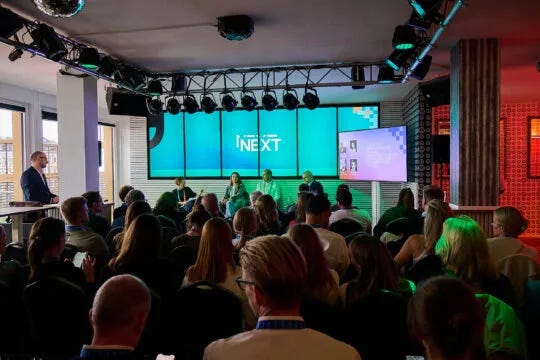
What happens when artificial intelligence meets healthcare and longevity science? At NEXT25, we gathered three experts to explore how healthcare is transforming before our eyes – and why the future might arrive sooner than we think.
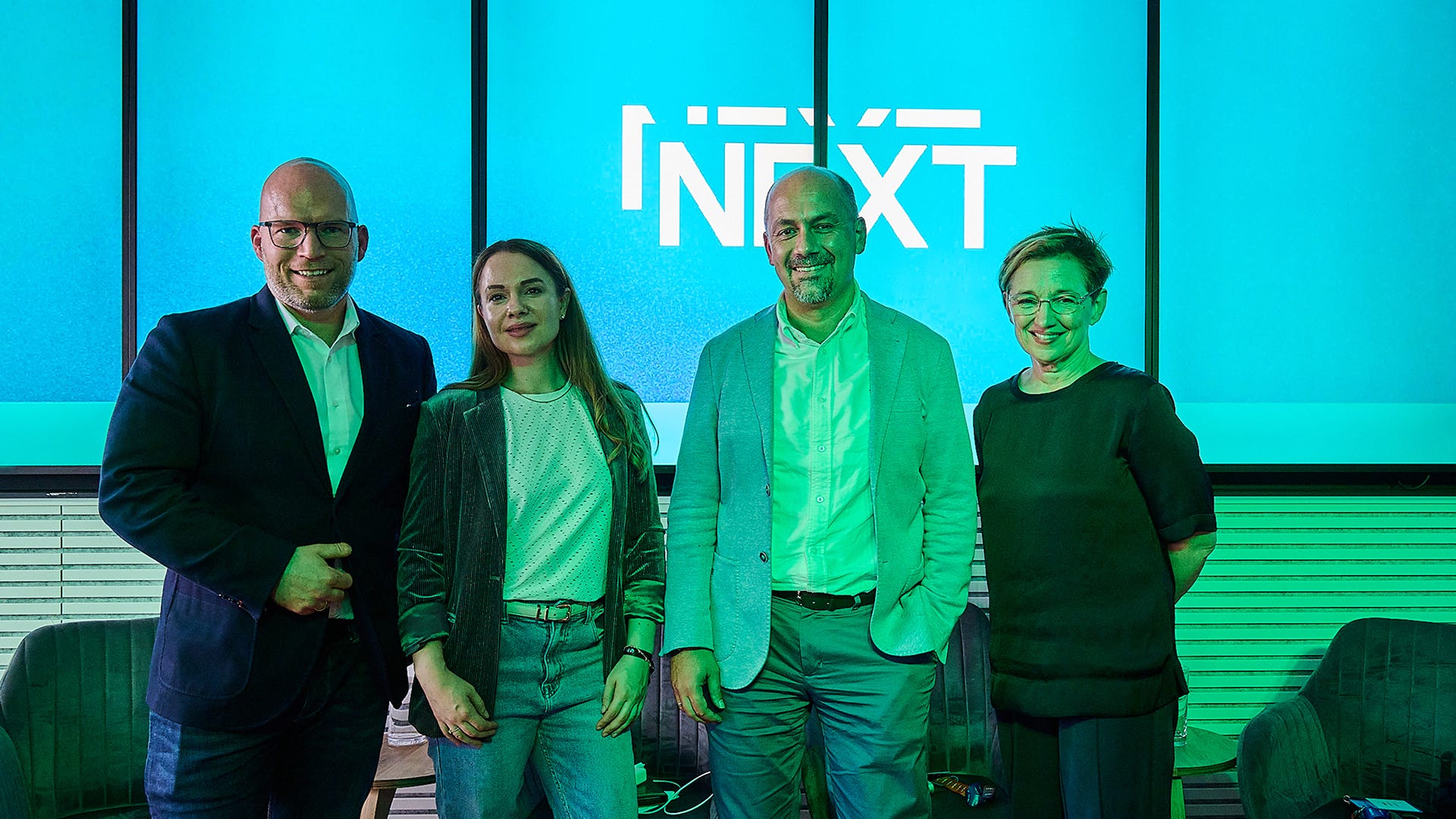
“Ideally, I want to die when I want to die“. That’s how Ramin Assadollahi, founder and chairman of ExB, opened our healthcare panel, immediately setting the tone for one of the most thought-provoking discussions at this year’s NEXT Conference. Alongside Christian Winterfeldt, senior director global specialty sales at Dell, and Jana-Irina Luley, senior director & general manager enterprise Germany at Dell Technologies, Ramin didn’t just talk about incremental improvements to healthcare – he painted a picture of a complete transformation that’s already underway.
The conversation, led by Monique van Dusseldorp, wasn’t theoretical. These aren’t distant possibilities we’re discussing – they’re realities happening in labs and hospitals right now.
The four levels of life extension
Ramin laid out what he calls the “four escalation levels” of longevity intervention:
Sleep, physical activity, and nutrition (SPAN) – Basic life extension measures we’re already familiar with
Supplements – The nutritional and pharmaceutical interventions many are exploring
Genetics, blood exchange, feces transplants – Advanced biological interventions that are entering clinical reality
Transferring the mind to non-biological storage – The ultimate technological transcendence
Before dismissing life extension as fantasy, consider this: researchers have already used CRISPR to activate the FOXO3 longevity gene in monkeys, effectively reversing their biological age. The study, published in Cell, proves that ageing isn’t an unchangeable biological law – it’s an engineering problem we’re starting to solve.
AI: The ultimate research assistant
Here’s where things get really interesting. While genetic research provides us with targets, AI gives us the speed and scale actually to achieve them. We now have five health-related large language models, nine DNA-trained LLMs (including BioReason), and 13 health-related MCP servers that can plug into existing AI workflows. These aren’t just tools – they’re research partners that can test hypotheses and iterate through possibilities faster than any human team.
But AI in healthcare isn’t just about processing text. As Ramin put it, we’re dealing with “multimodality beyond image and text” – complex molecular networks, massive datasets, and biological simulations that would be impossible without AI’s computational power.
Digital Twins: Your virtual self
Imagine having a complete digital copy of your body – not just your medical records, but a working simulation of your heart, your immune system, your genetic predispositions, everything. That’s the digital twin revolution, and it’s closer than you think. We already have 16 different types of digital twins covering hearts, tumours, and arteries. The goal? A fully integrated digital twin that captures you at multiple biological levels.
Christian shared a real example from Northwestern Medicine, which is working with Dell. They’re using genome sequencing to create personalised treatment plans and digital twins that help treat future patients. The University of Essen has a similar system helping hospitals decide what to buy when new patients arrive. This stuff is happening now, not in some distant future.
Jana emphasised how we’re shifting from one-size-fits-all medicine to truly personalised treatment. And the results speak for themselves. Ramin described a study in which AI monitoring of heart rates reduced death rates by 80% – just from better monitoring and AI analysis.
The speed of change
Jana’s timeline for major breakthroughs? Three to five years. Not decades – years. Organisations like TGen – the Translational Genomics Research Institute – are already using AI to break down barriers between previously isolated datasets, accelerating discovery at a pace that’s frankly a bit scary.
However, Christian pointed out that healthcare isn’t actually behind on technology adoption, as many people think. Hospitals have tons of data – they just need help organising it, a task AI excels at. Based on the projects he’s seeing, adoption is happening faster than the headlines suggest.
The economics are wild
Consider the future scenario Ramin described: every newborn has their DNA sequenced at birth. We create a catalogue of their potential diseases and intervene proactively. Instead of spending millions treating late-stage cancer, we spend thousands preventing it.
The economic incentives are aligning perfectly, but the ethical questions are massive. Who controls this genetic information? How do we prevent discrimination? These aren’t technical problems – they’re societal ones that we need to solve now.
What this means for you
From a patient perspective, the longevity field can feel overwhelming. There are supplements everywhere, researchers selling their own “truths,” and conflicting advice at every turn. Ramin’s advice? Integrate different approaches into your own framework and make informed judgments.
However, the bigger picture is this: if you’re under 50, you’re likely to live through the most dramatic transformation in healthcare in human history. If you’re under 30, you might see ageing become optional.
The revolution is here
Each panellist shared their vision for the future:
Jana: “To cure cancer” (and based on what we heard, that might not be as crazy as it sounds)
Ramin: Universal genome sequencing, where everyone knows their risks and acts proactively
Christian: Exponential growth in data-driven healthcare, transforming every aspect of medical practice
But here’s what struck us most: none of them talked about this as a future possibility. They’re all working on pieces of this puzzle right now.
The bottom line
We’re not waiting for a healthcare revolution – we’re living through it. The combination of AI and longevity science isn’t just changing how we treat disease; it’s changing our fundamental relationship with mortality itself.
The technology exists. The data is there. The economic incentives are aligning. The question isn’t whether this transformation will happen – it’s how thoughtfully we’ll navigate it.
Here at NEXT, we believe in exploring technology’s potential while acknowledging its complexity. This healthcare revolution embodies both the promise and the responsibility of our technological moment. We’re not just witnessing the end of healthcare as we know it – we’re participating in writing its next chapter.
The future, as always, remains a choice we make together.
More about NEXT25
The age of multiple endings: when everything that stands begins to fall
Innovation in Motion: Green energy, mobility and the future of transport
Shaping the future of urban mobility: Voices from the road ahead
First published at nextconf.eu.